
Choose the Right Paducah Record
Start with the question, not the record. For a current owner in Paducah, the McCracken County Property Valuation Administrator, or PVA, is the sound first stop. The county clerk holds the title side: deeds, mortgages, plats, wills, and other recorded papers. Kentucky's voter center can confirm a single registration. The legal name and date of birth must be known. Printed directories and census records do better work on an older household.
No official roll lists every occupant. A parcel card names an owner. Its tax-mail address may differ from the street address. A voter result covers one registered voter, not a whole home. Court and deed indexes record parties to events, not the general run of Paducah residents. So build a narrow trail. Stop once two independent sources answer the question.
- Search the PVA by owner or address, then record the parcel number, situs address, mailing address, sale history, and legal description.
- Use the Kentucky Voter Information Center for a current registration when the legal name and birth date are available.
- Carry the owner name and legal description into the McCracken County Clerk records route to locate the deed chain.
- For past households, compare a city directory year with a census, obituary, cemetery, or probate source.
- If the needed record is not online, send a precise request to the custodian under the Kentucky Open Records Act.
Paducah's Resident Record Keepers
Three offices anchor the Paducah residents directory. The McCracken County Clerk records land papers, handles voter registration, and issues marriage licenses. The PVA keeps the tax roll, parcel cards, and property descriptions. It also holds sales data and GIS research tools. State election officials run the individual voter lookup. The county clerk stays the local election contact. Each office can explain its own index and fix errors within its custody.
McCracken County Clerk
300 Clarence Gaines Street
Paducah, KY 42003
Records: (270) 448-1540
Kentucky Voter Center
Statewide individual lookup
Paducah registration records
Local clerk: (270) 444-4700
For a street-wide question, the address method is worked out in the Paducah street directory. That workflow keeps parcel ownership separate from claims about occupancy.
Paducah Parcels Have Three Addresses
Paducah parcels carry three different addresses in the PVA's property tools. Each one means something distinct. The situs address is simply where the land sits. The tax-mail address is where notices go, and it can differ entirely. Then there is the legal description. It pins down the parcel through lot, block, boundary, or other recorded language rather than a street number. Treat these three fields as separate facts, never as interchangeable synonyms.
- Parcel
- A mapped unit of land with its own identifier in the assessment system.
- Situs address
- The street location assigned to the property itself.
- Index
- A finding list that points to a document; it is not the certified document.
- Criss-cross directory
- A directory arranged by address or street, allowing an address-to-name search.
Tools like MAP~GIS and Qpublic put a parcel on the ground, but the PVA itself cautions that GIS lines are approximate. When a boundary actually matters, go to the recorded deed and plat. That habit guards against a common Paducah mistake: pasting the owner's tax-mail location onto the house you are tracing.
Paducah Deeds Connect Resident Names
The McCracken County Clerk records office is the gateway for deeds, mortgages, liens, plats, wills, powers of attorney, and UCC or fixture filings. eCCLIX is the online route in. The county page names no single start year covering every McCracken document group. So avoid assuming one. A personal account is described as limited to five daily searches, with other subscription options available.
A deed index typically names the grantor and the grantee. The grantor gives an interest. The grantee takes it. Expect instrument type, recording date, book and page or document number, and a path to the image. The index is only a lead, though. The recorded image itself carries the full names, signatures, legal description, source-of-title language, and the terms that confirm the transfer.
Older deeds run deeper. The Kentucky Department for Libraries and Archives inventory documents McCracken deed microfilm from 1825 through 1995, and it fills the gap when an online search stops short. From there, contact the clerk for the paper, film, or certified copy. Never guess an eCCLIX start date.
Current Paducah Resident Directory Sources
A Paducah residents directory draws on several current sources, each with its own purpose. The property roll is the strongest for owners and parcels. The voter center confirms one individual registration. The deed index names parties to recorded instruments. CourtNet adds a delayed statewide case-search layer. The court clerk holds the actual McCracken file. Business and license searches can confirm a public role or affiliation. Neither proves where someone lives.
| Paducah source | What it can confirm | Official keeper | Access route |
|---|---|---|---|
| PVA property roll | Owner, parcel, situs, mailing address, sale and building facts | McCracken County PVA | Free Qpublic target or office help |
| Voter Information Center | One person's current registration and polling information | Kentucky State Board of Elections | Free individual lookup |
| Recorded-document index | Parties to deeds, liens, mortgages, wills, and plats | McCracken County Clerk | eCCLIX account or clerk request |
| CourtNet and case file | Case association, then the filed record where open | Kentucky Court of Justice and local clerk | Portal plus clerk copy route |
| Business and license search | Entity role or professional credential | Kentucky SOS or licensing office | Free state search |
Government rolls answer to a named custodian. Each Paducah index exists because a records office must keep it. That gives residents a source they can trust for street addresses and property details. Commercial people-finder sites blend records from many places. They go stale and sometimes merge two people who share a name. Treat the residents directory as a starting point. Then confirm anything that matters against the original public roll.
Kentucky Voter Lookup Fields
The Kentucky Voter Information Center works one voter at a time. It confirms a single registration rather than listing a whole block, so it suits a resident lookup on a known individual. The form asks for legal first and last name, date of birth, and optionally the last four digits of a Social Security number. A valid match can return current registration status, polling-place details, and absentee information.
| Lookup field | Format | Required | Use |
|---|---|---|---|
| Legal first name | Text | Yes | Match the registration name |
| Last name | Text | Yes | Narrow the voter record |
| Date of birth | Date | Yes | Separate same-name registrants |
| SSN last four | Four digits | No | Optional added confirmation |
Voter records sit under KRS 116.095 and the request rules set by the State Board of Elections. Social Security numbers are redacted before release. What a requester may see, and how the data can be used, depends on the format requested and on the requester. Safe at Home lets a participant's physical address be swapped for a substitute address in public agency records.
Paducah Courts Need Two Checks
Kentucky CourtNet and the McCracken Circuit Clerk sit on two different layers. CourtNet is a search surface. It shows a delayed snapshot, and it carries its own guest and account rules. The clerk, by contrast, holds the filed case record itself. Local copies, archived material, and docket questions all belong at the clerk's counter. A docket is simply the chronological list of filings and events in a case.
The Kentucky Department for Libraries and Archives keeps historical judicial indexes as well. Its archive offers county, court, name, and date controls. Once an entry turns up, the accession details let you request the underlying item. Sealed, expunged, confidential, and otherwise restricted records do not become open just because a related name appears in an index. Same-name results are common in Paducah court work. So weigh a middle initial, an address or county, a date range, a related party, and the case type before trusting a match. The full one-person verification sequence lives in the Paducah resident lookup.
Paducah's Historical Resident Directory Shelf
McCracken County Public Library genealogy collection reports Paducah city directories reaching from 1859 to the present, with gaps along the way. The same shelf holds census material, newspapers, vital indexes, deeds, wills, court sources, photographs, family files, and local subject files. Confirm exact printed years and reverse-directory runs with library staff. Assumptions cost time here.
The FamilySearch catalog lists Paducah material in an 1871–72 Ohio River directory plus a city directory and history for 1894–95. A printed entry may carry a name, spouse, occupation, business, street address, a widow notation, or an owner-versus-renter mark. Abbreviation keys matter. Publishers shortened occupations and street terms alike, so the key unlocks the entry. The library's official genealogy page displays the collection itself.
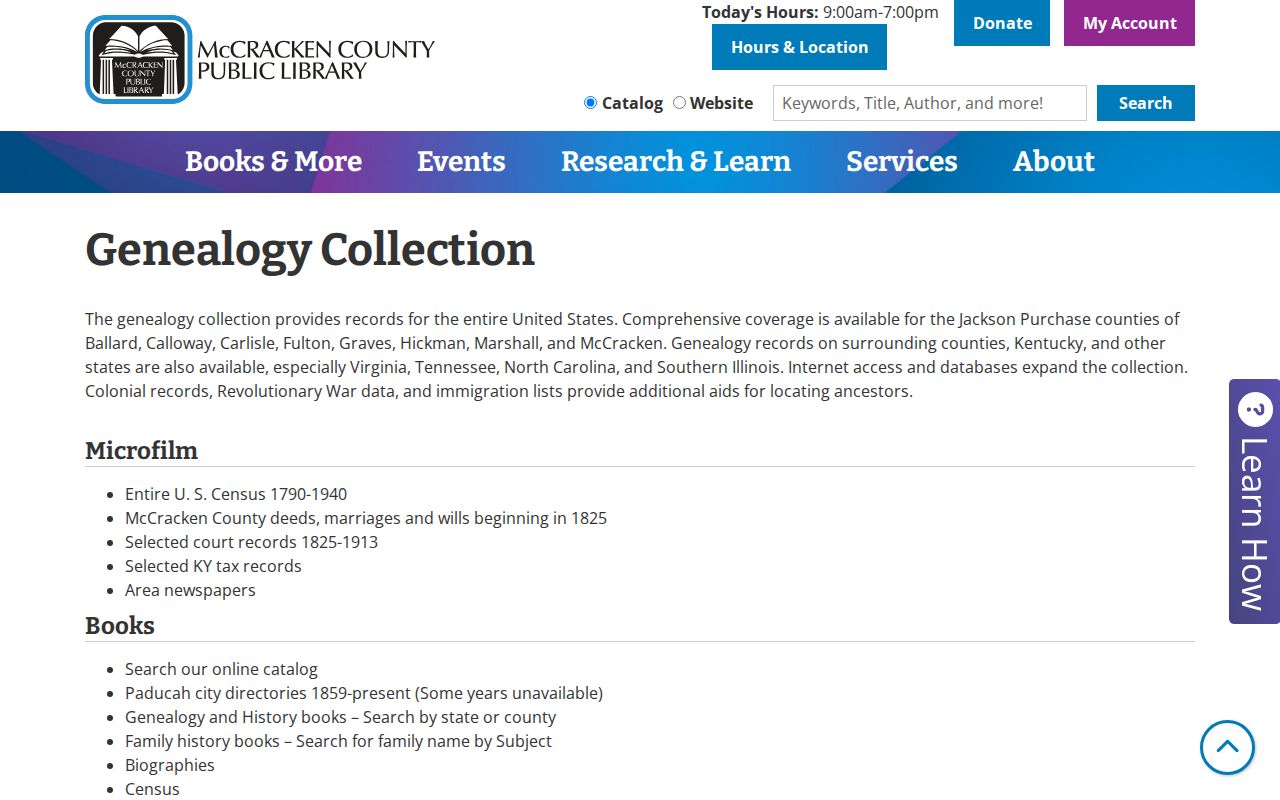
The genealogy page shows that directory research pairs well with local microfilm, photographs, newspapers, and family files. No Paducah search should lean on one printed name alone.
Oak Grove Extends Paducah Records
Oak Grove Cemetery gives Paducah researchers a city-run historical name source. The cemetery dates to 1847. The city's history notes interment books reaching back to 1909. Public search fields cover last name, first name, year, and veteran status. A burial entry can anchor a death date, family link, lot location, or obituary search. It works best paired with a vital, newspaper, probate, or directory record. The Oak Grove Cemetery page and interment search documents the city's burial resource.
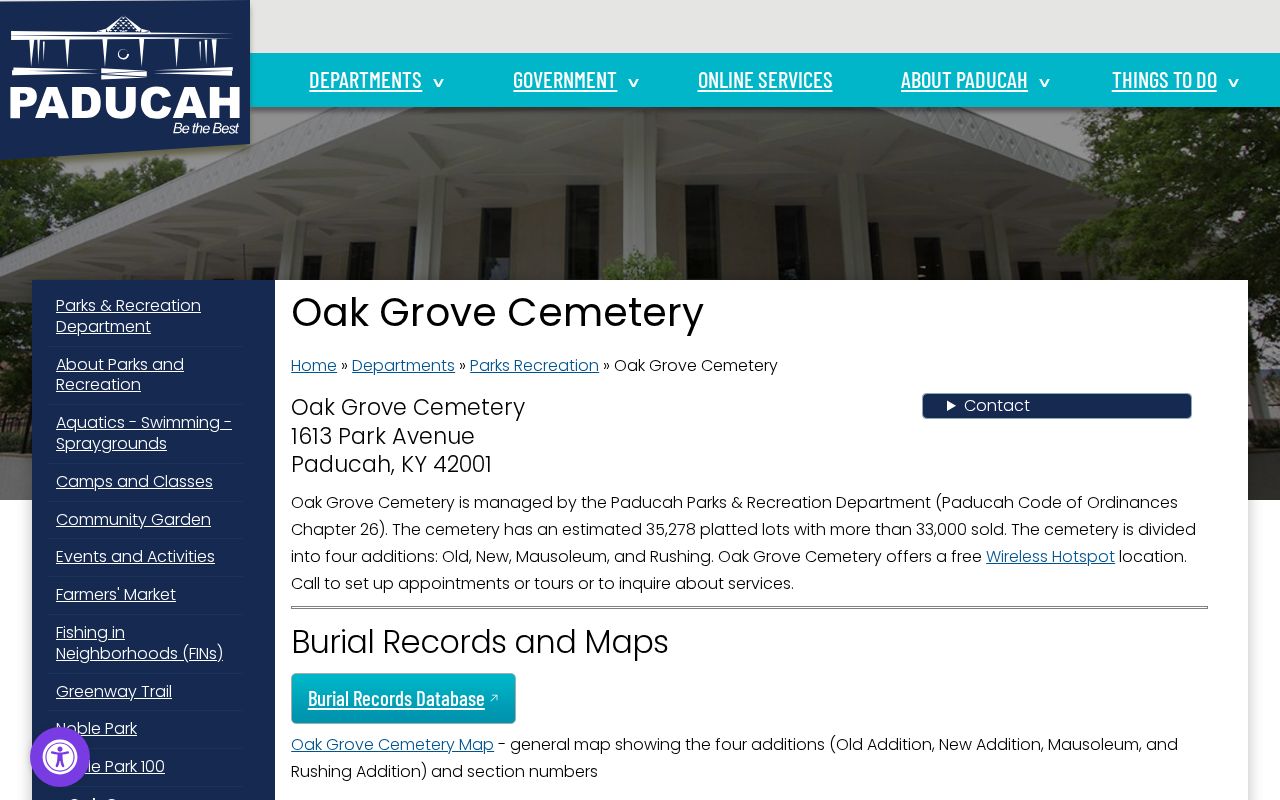
The search screen offers a focused route for Paducah family research. A name or year leads to a cemetery record, and from there to the library and probate sources.
Paducah Business Names Need Context
The Kentucky Secretary of State business search confirms an entity name, status, registered agent, and public filing roles. Those fields document a business connection, not a residence. Search variants of an entity name and handle the active-only control with care. When the summary is not enough, inspect the filed documents. The Kentucky Business Entity Search provides Paducah's statewide business-record route.
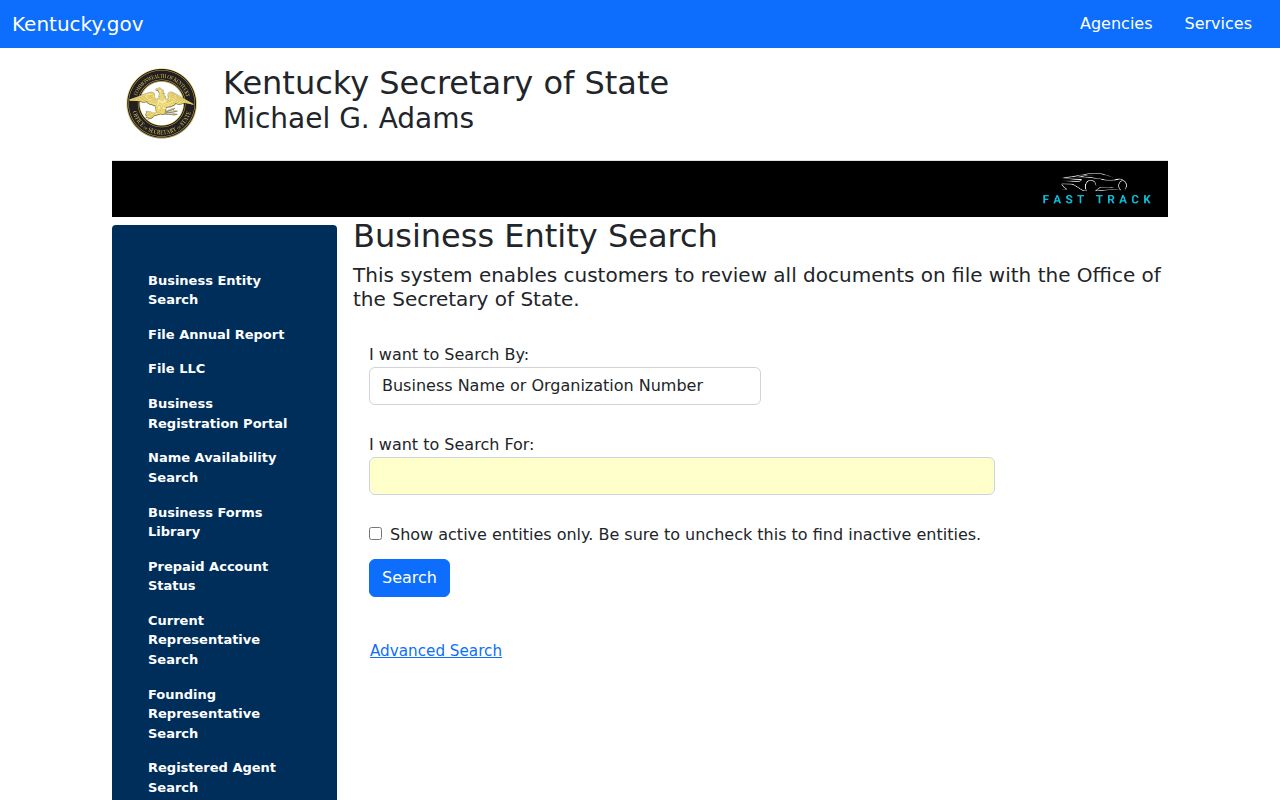
The form separates a company record from a resident claim. That distinction keeps a registered-agent address from being mistaken for a home. The Kentucky professional-license search performs a different job. It searches individuals or firms through boards, status, city, state, and ZIP controls. Use it to confirm a credential and its official status. Then cite the board record and its verification date. The Kentucky professional license search is the official source for that check.
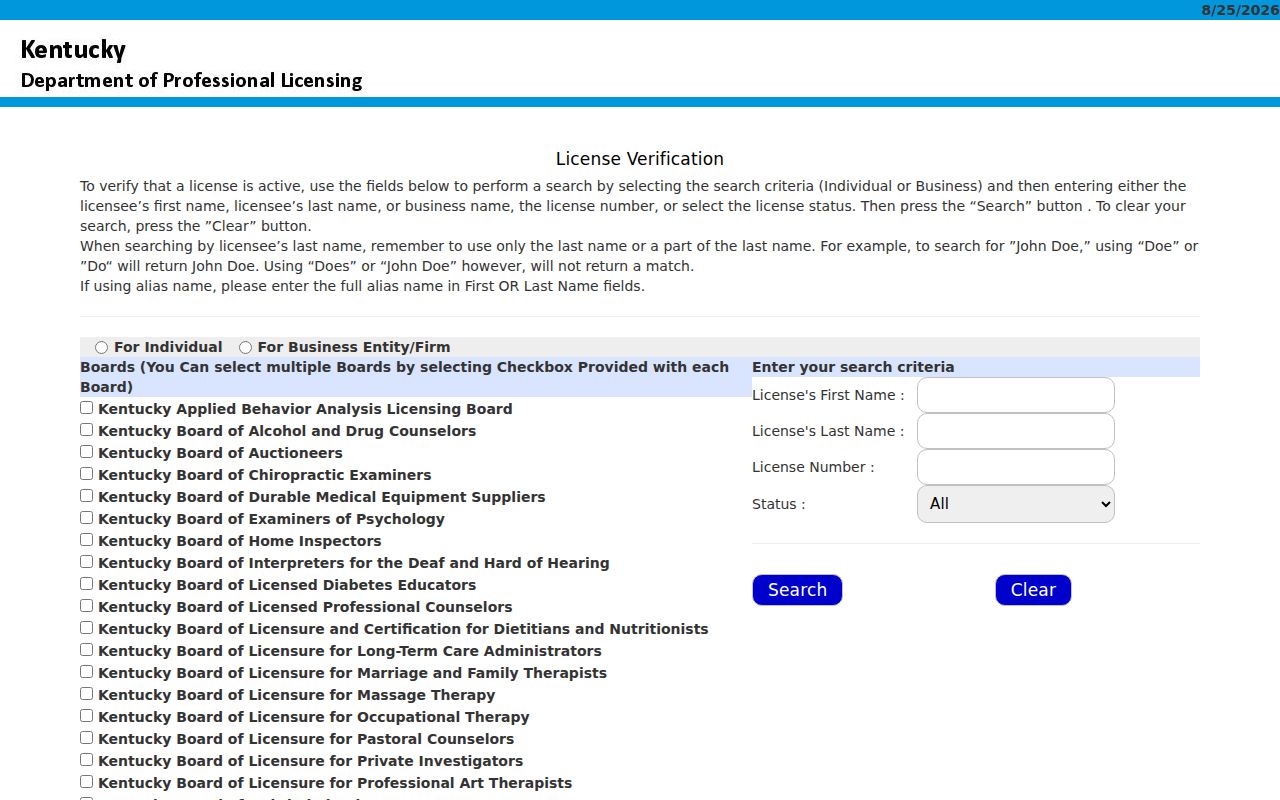
Board and status filters make the point plain. A license result belongs in a Paducah residents directory only as a public affiliation, never as proof of a household.
Paducah Records Have Protected Edges
Kentucky law keeps some personal details out of open view. Birth and death access is restricted under KRS Chapter 213. Older registrar records open on the schedule in KRS 213.131, which sets 100 years after a birth and 50 years after a death. Central marriage and divorce certificates begin in June 1958. Earlier Paducah marriage work goes back to the county clerk, while earlier divorce files belong with the circuit clerk. Kentucky Safe at Home gives qualified participants a substitute address for public records and mail forwarding. Voter records carry redaction and use rules of their own. A missing physical address does not mean the resident left Paducah, and a protected address must never be reconstructed from other rolls.
Lawful use. Use Paducah resident records for personal research, genealogy, civic checks, and fraud prevention. Never use a record to stalk, harass, threaten, or harm anyone.
Request Missing Paducah Resident Records
The Kentucky Open Records Act, KRS 61.870 through 61.884, is the fallback when a public record sits outside any web portal. Identify the custodian first. The county clerk handles recorded papers, the PVA handles assessment files, the city clerk handles municipal records, and the circuit clerk handles local court files. A short, exact request beats a broad demand for everything tied to a person.
State the record type, the name or address, the date range, and any known parcel, instrument, case, or permit number. The McCracken County Clerk policy describes a five-working-day response rule along with its copy-fee process. Kentucky Attorney General open-records guidance supplies the standard request form and the appeal route. A response may point to an existing portal, seek clarification, apply a lawful exception, or provide copies.
Note: Keep the request and response together so the custodian, search date, omissions, and record version stay clear.
Current Paducah Directory Changes
Start any Paducah record search with the property side. The PVA now runs its public presence from the official mccrackenpva.gov domain. Qpublic remains the linked search target behind it. That arrangement gives you a quick anti-scam check. Verify any property notice against the official PVA phone and site before you touch a payment link.
Two newer tools deserve a look as well. McCracken DocAlert sends a free email whenever a deed or mortgage is filed. It covers a name or business you register. It monitors filings. It is not a deed archive or a title opinion. Paducah also announced free Scope My Project portals in July 2026. They generate customized zoning and permit summaries for an address. Those summaries can clarify a property's allowed use, but they do not amount to a resident roll for the city directory side of your work.
Older addresses call for dated comparisons. The original 1830 plat laid out twelve blocks. It ran between Oak and Fourth, Clark and Jefferson, and the river. The 1937 flood, and the floodwall work that followed, can account for breaks in an address trail. Treat any single source as provisional. Set the deed's lot and block beside a Sanborn sheet, a directory year, and PVA aerial imagery. The PVA offers aerial layers from 1938, 1950, 1952, 1964, 1981, 2001, 2008, and later flights. Those dated views help you tell a household that moved from a building or street reference that simply changed.
Expect this landscape to keep shifting. Cite the custodian, the portal, and your access date, and preserve the parcel or document identifier. When a result conflicts with the deed, vital certificate, or court file, return to the official records office.